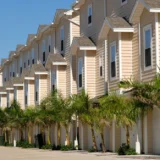
The money is to be used to buy properties and rent them out but critics say it probably won't make much difference especially in areas like Miami, Jacksonville and Naples where the number of foreclosures are already among the highest in the US and expected to increase by 15% next year as recession has an impact on jobs.
In these areas job growth is expected to drop to 4%. Overall the Bureau of Labor Statistics predicts that the macro economy will shed a net of 1.3 million jobs.
'It is far from recovery. You can drop the price of a new property to zero and still not sell it because there is no one there to buy it,' said Doug Duncan, chief economist of Fannie Mae.
'Traditional foreclosure factors like job loss in the private sector look like they're going to peak at the same time as the peak of non-traditional factors like price declines. It is our worst fear,' he added.
This scenario is adding to the problem as many would-be sellers confronting rapidly falling prices are opting to walk away from their homes.
It's not much better in California where foreclosures in troubled areas like Fresno, Santa Cruz and Santa Barbara are expected to rise between 11% and 14% next year.
However there is some home in California. Job growth figures are better than in Florida, and new housing permits have begun to bottom out, cutting into supply. Even though prices are down, transaction activity has grown 17% in San Diego, 21% in Los Angeles and 32% in Sacramento from last year, according to Radar Logic, a New York-based research firm.
'We're starting to see signs of a bottom in some places in California which were the first to crash,' said Scott Hoyt, a senior director of consumer economics at Moodys. 'But declining house prices with ongoing job losses means that the housing cycle is still deteriorating. We may be getting toward the bottom on construction activity, but we're not there in terms of price or credit quality,' he added.
The US economy is currently in a recession that will not end until the middle of next year when a slow recovery begins, according to the Mortgage Bankers Association, citing rising unemployment, contracting manufacturing activity and declining inflation-adjusted consumption spending. Jay Brinkmann, the trade group's chief economist, predicted that unemployment will climb to 7.8% by early 2010 before decreasing.