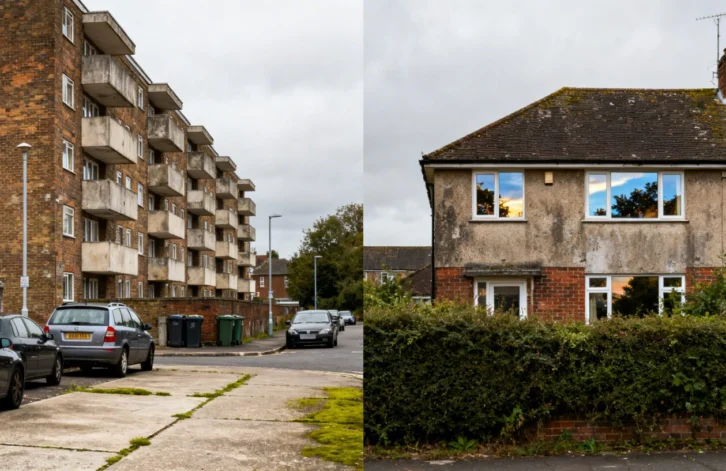
Estate agents operating in urban markets need to complete a higher volume of transactions to match the earnings of counterparts in rural areas, according to research from eXp UK.
The analysis examined average agent fees across English regions and applied them to typical property prices, revealing that commissions from detached homes are on average 73% higher than those from flats. Urban markets, which are dominated by flat sales, therefore require agents to handle more transactions to generate comparable income.
Regional variations in commission levels
The study found substantial regional differences in earning potential based on property type. The South East recorded the largest disparity, with agents earning an estimated £10,641 from a detached home compared with £3,278 from a flat—a difference of 105.8%. This means agents need to complete more than three flat sales to match the commission from a single detached property transaction.
The West Midlands showed a 99.7% gap between detached homes and flats, whilst the East Midlands and North East recorded differences of 96.1% and 95.4% respectively. In the South West, commissions from detached homes were 95.2% higher than those from flats.
London exhibited the smallest gap at 91.2%, reflecting the capital’s higher flat values. However, even in London, agents selling flats face the same requirement for higher transaction volumes to achieve income parity with those selling detached properties.
Market implications
Adam Day, head of eXp UK and Europe, said: “Agents working in urban markets are often dealing with higher volumes of flats, which on the surface can look positive, but the reality is that the commission secured per sale is significantly lower than for detached homes.”
He added: “In many regions, an agent needs to sell more than two flats, and in some cases closer to three, just to match the commission earned from a single detached property transaction. That has a real impact on workload, time pressures and long-term earning sustainability.”
Conclusion
The research highlights how regional housing stock composition directly affects agent earning potential and workload requirements. The findings indicate that agents in flat-dominated urban markets face structural challenges in balancing transaction volume with income generation compared to those operating in areas with higher proportions of detached properties.