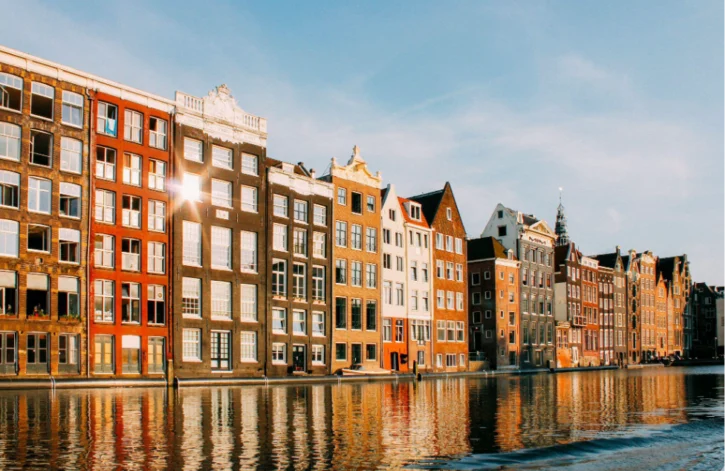
Amsterdam continues strengthening its position as one of Europe’s most important starting points for river cruising as operators expand itineraries across the Rhine, Main and Danube corridors.
The Dutch capital remains a major gateway for travellers beginning longer journeys through Central Europe, supported by its aviation links, established port infrastructure and direct access to interconnected inland waterways.
River cruising across Europe has grown steadily in recent years, with industry reporting showing increasing demand for smaller-scale travel experiences focused on cultural routes, historic towns and multi-country itineraries. A recent travel industry report noted that the global river cruise market is projected to approach $10 billion in sales by 2030, with European waterways remaining the sector’s dominant segment.
Amsterdam plays a central role within that network because of its geographic connection to major inland river systems extending through Germany, France, Switzerland, Austria and Eastern Europe.
The city is also increasingly functioning as both a destination and operational hub, with many itineraries either beginning or ending in Amsterdam before continuing through the Rhine corridor toward Basel, Budapest or Vienna.
Amsterdam canal cruising supports wider river tourism
Amsterdam’s long-standing connection with inland waterways continues supporting broader river tourism growth across Europe.
The city’s canal infrastructure and maritime heritage make it a natural entry point for travellers transitioning from urban sightseeing into longer continental river journeys. Smaller canal cruises operating within Amsterdam itself also contribute to the wider river tourism ecosystem by familiarising visitors with inland water-based travel before larger itineraries begin.
Several operators now integrate Amsterdam canal experiences alongside extended European river routes covering destinations across the Rhine, Main and Danube corridors.
Industry commentary from cruise operators and tourism organisations increasingly describes Amsterdam as one of Europe’s most recognisable river-cruise embarkation points because of its accessibility and connection to broader inland shipping networks.
The combination of international air access, hotel capacity and central docking infrastructure allows operators to efficiently rotate passengers through multi-country cruise schedules.
This logistical advantage remains particularly important as river cruise operators continue expanding route variety across Europe.
Rhine corridor remains central to European river cruising
The Rhine continues operating as one of Europe’s busiest and most commercially important river cruise corridors.
Routes departing Amsterdam commonly travel south through Germany toward Cologne, Koblenz, Strasbourg and Basel, connecting passengers with historic urban centres and wine-producing regions along the way.
Several operators now position Amsterdam as the starting point for journeys combining the Rhine with the Main and Danube waterways through linked canal systems.
This allows passengers to travel across large sections of continental Europe without changing ships.
The Rhine’s popularity is partly driven by geography. Unlike some other river systems, it connects densely populated urban areas while also passing through highly marketable scenic regions including vineyard landscapes, medieval towns and UNESCO-protected sections of river valley.
Amsterdam-to-Basel and Amsterdam-to-Budapest itineraries are among the sector’s most recognisable long-distance routes. These itineraries remain commercially important because they combine multiple countries within relatively compact travel schedules.
Operators continue expanding route diversity
European river cruise operators are increasingly broadening itinerary offerings beyond traditional sightseeing-focused routes.
There is a growing interest in themed itineraries centred around food tourism, cultural programming, active excursions and longer regional exploration.
Amsterdam’s role within this market has expanded partly because it provides operational flexibility for different cruise structures.
Some itineraries focus primarily on the Netherlands and Belgium inland waterways, while others position Amsterdam as the northern anchor point for extended continental routes.
Cruise companies including CelebrityCruises, AmaWaterways, Scenic, Uniworld and other European river operators have all continued expanding or refining multi-country itineraries linked to Amsterdam departures.
This diversification reflects changing traveller demand patterns.
Rather than viewing river cruising solely as a luxury retirement market, operators are increasingly targeting:
- multigenerational travellers
- active travellers
- solo passengers
- culturally focused tourism
- extended-stay visitors
Also, smaller vessel sizes and city-centre docking remain important competitive advantages compared with larger ocean cruising formats.
Sustainability pressures are reshaping Amsterdam operations
Amsterdam’s position within the river cruise sector also faces increasing environmental and tourism-management pressures.
The city has introduced measures aimed at reducing congestion and limiting environmental impact associated with growing cruise activity. Recent reporting noted that Amsterdam plans to reduce river cruise stops significantly over the coming years as part of broader overtourism management efforts.
New environmental standards linked to Green Award certification are also becoming increasingly important for operators docking within Amsterdam.
This is gradually influencing fleet modernisation and route planning decisions across parts of the industry.
Several operators are already investing in lower-emission vessels, improved waste systems and alternative propulsion technologies in response to tightening environmental expectations.
At the same time, Amsterdam remains difficult to replace operationally because relatively few European cities offer comparable combinations of:
- international connectivity
- established inland port infrastructure
- tourism demand
- direct access to major river systems
This means the city is likely to remain commercially important even as operational rules become stricter.
Inland waterways remain commercially valuable
Europe’s interconnected inland waterways continue supporting both tourism and commercial transport activity.
The Rhine-Main-Danube canal system remains especially significant because it effectively links the North Sea with Central and Eastern Europe through navigable inland routes.
River cruise operators benefit from infrastructure originally developed around freight movement and industrial navigation.
This network allows relatively seamless travel between countries including the Netherlands, Germany, Austria, Hungary and Romania.
Amsterdam’s role at the northern edge of this system strengthens its strategic position within European river tourism.
The appeal of slow-travel formats make this a place where passengers experience multiple destinations without repeated airport transfers or complex overland logistics.
River cruising aligns closely with that trend because routes naturally integrate transport, accommodation and sightseeing into one continuous itinerary.
Demand remains concentrated in Central Europe
Although river cruising exists globally, Central Europe continues dominating international demand.
Amsterdam benefits directly from that concentration because it serves as one of the primary northern entry points into the wider network.
The city also appeals to travellers arriving several days early before embarkation, contributing additional tourism spending beyond cruise operations themselves.
This broader economic relationship between river tourism and urban tourism infrastructure continues reinforcing Amsterdam’s importance within the sector.
As operators continue refining itineraries, adapting to sustainability requirements and expanding route diversity, Amsterdam appears likely to remain one of Europe’s most strategically important starting hubs for river cruising.
——————————————-
Author: Shanzaib-Haider
Shanzaib Haider is a travel writer and blogger dedicated to the idea that exploration is the ultimate teacher. As the voice behind WanderlustCraze.com, he turns his personal adventures into relatable guides that encourage readers to nurture the spirit of discovery.