The UK property market has long been a source of frustration for investors: high stamp duty, capital gains tax, compressed yields, and an increasingly complex regulatory environment have all chipped away at returns. Against that backdrop, it’s no surprise that UK buyers are looking further afield – and Dubai has emerged as one of the most compelling alternatives available.
What was once a market associated with speculative luxury purchases has matured considerably. Today, Dubai offers a transparent freehold framework, no property tax, no capital gains tax, and gross rental yields that routinely double what’s achievable in London. For UK buyers looking to diversify, generate income, or plant a longer-term flag in a fast-growing global city, the case for exploring houses in Dubai for sale has rarely been stronger.
The Dubai Property Market in 2026: Resilient, Active, and Maturing
Dubai’s property market has undergone a remarkable transformation over the past five years. Residential sales transactions exceeded 200,000 in 2025 – a 464% increase from 2021 – supported by end-user demand, strong investor confidence, and sustained international interest. That’s not a speculative bubble dynamic; it’s a market being driven by people who actually want to live there.
Dubai Land Department data showed real estate transactions reached around AED 761 billion in 2024, a 20% increase from 2023, and momentum carried into 2025 and 2026. Over 58% of property transactions in Q2 2025 were driven by international investors, with buyers from India, the UK, China, and Russia acquiring assets across both primary and secondary markets.
The growth rate is moderating – deliberately so. Price appreciation in Dubai is forecast at 5% to 8% in 2026, down from the 12% to 22% annual growth seen during 2024 and 2025. For buyers, this is actually good news: it signals a market transitioning from momentum-driven speculation to fundamentals-driven stability. Experts describe the market as shifting toward long-term value, where growth is stable rather than explosive.
The regulatory environment has kept pace. Ongoing improvements in digital transactions and tenancy laws have increased transparency, reducing risk for overseas investors. Dubai’s Real Estate Regulatory Authority (RERA) oversees developer conduct and buyer protections in ways that make the market meaningfully safer than it was a decade ago – an important consideration for UK buyers accustomed to a robust legal framework at home.
Why Houses in Dubai for Sale Appeal to UK Buyers
The financial case is straightforward, and it starts with what Dubai doesn’t charge you.
A genuinely tax-free environment. Dubai does not charge any annual property tax, and there is no tax on rental income. In many global cities, landlords lose 20% to 40% of rental income to taxes. In Dubai, you keep everything. For a UK investor currently navigating income tax on rental profits, the difference is material – and immediate.
No capital gains tax. In the UK, selling a buy-to-let property or second home currently attracts capital gains tax at up to 24%. In Dubai, your entire gain on disposal is yours to keep. Over a multi-year hold, this difference compounds significantly.
Rental yields that outperform London. Gross rental yields in Dubai average around 6.7% to 7% for apartments – roughly double what investors earn in mature cities like London or New York. For villas and townhouses, gross yields sit at around 5%, still comfortably ahead of comparable UK residential properties.
Currency and portfolio diversification. Dirham-denominated assets offer UK investors genuine diversification away from sterling and the UK economic cycle. Buyers from the UK and Europe are leveraging currency exchange rates and growing confidence in Dubai’s regulatory environment to acquire dirham-based assets for long-term gain.
The Golden Visa. Purchasing a property worth AED 2 million or more qualifies buyers for a 10-year UAE Golden Visa, covering a spouse and children. In 2026, off-plan properties also count toward this threshold. For UK buyers considering spending extended periods in the UAE – whether for lifestyle, business, or tax planning purposes – this is a significant added benefit.
Lifestyle. Beyond the numbers: Dubai offers world-class infrastructure, year-round sunshine, international schooling, and a globally connected lifestyle that genuinely appeals to the professionals and families who make up the core of the UK buyer pool. It isn’t just an investment destination – for a growing number of UK buyers, it’s becoming a second home or a planned relocation.
Types of Houses Available in Dubai
Dubai’s residential market for houses spans a wide range of price points and property styles. Understanding the main categories helps frame both the investment case and lifestyle fit.
Luxury Villas: Trophy Assets in Trophy Locations
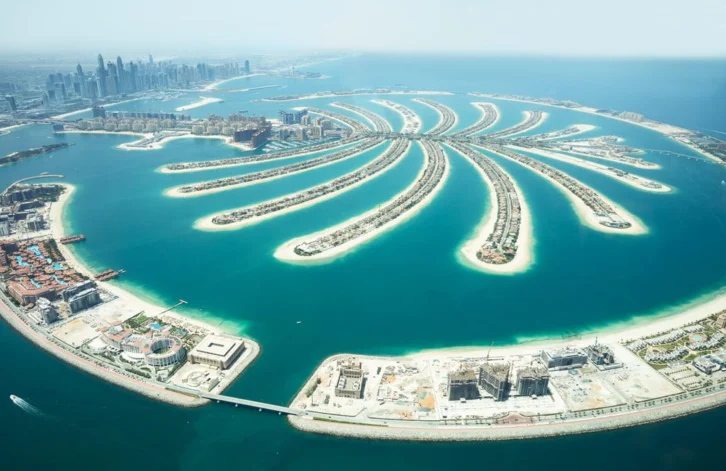
The upper end of Dubai’s villa market is anchored by Palm Jumeirah and Emirates Hills – addresses that command global recognition and price tags to match. Palm Jumeirah’s signature frond villas offer private beach access, waterfront terraces, and a density of amenities that few residential communities anywhere in the world can match. Emirates Hills is Dubai’s equivalent of Beverly Hills: large, gated, and very private.
Luxury real estate – especially waterfront villas and branded residences – has seen consistently rising demand, and cash purchases remain dominant in this segment. Entry prices for Palm Jumeirah villas typically start around AED 10-15 million (approximately £2.1-3.2 million), with larger frond properties reaching significantly higher. For UK buyers, these assets offer prestige, capital preservation, and strong short-term rental potential in one of the world’s most recognisable addresses.
Family Homes: Community Living With Strong Fundamentals
The most active segment of Dubai’s house market – and arguably the most compelling from a yield and stability perspective – is the master-planned family community. Arabian Ranches, Dubai Hills Estate, and Jumeirah Golf Estates are the flagship examples: gated developments built around parks, international schools, golf courses, and retail, with property management and community governance that’s often superior to anything available in equivalent UK suburban locations.
Villas, townhouses, and luxury properties consistently outperformed apartments in price growth, driven by demand for space, privacy, and lifestyle amenities. Three- and four-bedroom townhouses in Dubai Hills Estate and Arabian Ranches typically range from AED 3-7 million (approximately £630,000-£1.5 million), offering considerably more space and amenity than a UK property at a comparable price point.
Off-Plan Houses: Lower Entry, Higher Upside
Off-plan properties accounted for over 60% of transactions in 2025, driven by flexible payment plans and the potential for high capital appreciation.
The appeal for UK buyers is clear: off-plan properties are typically priced 10% to 15% lower than ready units, with many developers in 2026 offering 3- to 5-year payment plans requiring only a small amount during construction – no bank loan required. A typical structure might involve 10% at booking, 20% during construction, and 70% on completion – giving buyers time to arrange financing or benefit from currency movements before full commitment.
The risk profile is different from ready properties: developer reputation and project completion timelines are the primary variables to scrutinise. But for buyers with a multi-year horizon and appetite for the construction period, off-plan houses in emerging communities represent the market’s most attractive entry-price opportunity.
Key Areas With Strong Investment Potential
Not all of Dubai’s residential market performs equally. Here’s where the evidence points for houses specifically:
Dubai Hills Estate sits at the top of most analysts’ lists for 2026. It is among the top three Dubai neighbourhoods with the fastest-rising property prices in early 2026, combining constrained supply with strong lifestyle and investment appeal. Proximity to top schools, a championship golf course, and a major retail mall make it one of the city’s most desirable family locations – and supply in the villa segment is genuinely limited.
Palm Jumeirah remains the global flagship. Annual price growth in Palm Jumeirah ranges from 12% to 18%, driven by a combination of status, limited land, and consistently strong demand from international ultra-high-net-worth buyers. Not a yield play, but a capital appreciation and lifestyle asset.
Jumeirah Village Circle (JVC) is the value investor’s pick. JVC is expected to attract increased buyer activity in 2026 due to affordability and long-term development potential, with townhouses available at entry points well below AED 2 million. Rental yields here are among the strongest in the city.
Dubai South is the long-game location. Built around the Al Maktoum International Airport expansion – slated to become one of the world’s largest airports – Dubai South is gaining popularity as a mid-range and affordable housing area with significant future ROI potential. Currently priced at a significant discount to established communities, the investment case rests on infrastructure-driven appreciation over a 5-10 year horizon.
Arabian Ranches and Damac Hills round out the family community tier, offering established neighbourhoods with proven rental demand and the community infrastructure that relocating UK families typically prioritise.
Dubai vs the UK Property Market: Side by Side
For UK investors doing the comparison, here’s where the two markets actually differ – beyond the headline yield numbers:
| Factor | Dubai | UK |
| Rental yields (houses) | 5-7% gross | 3-4.5% gross (London lower) |
| Income tax on rent | 0% | 20-45% depending on income |
| Capital gains tax on sale | 0% | Up to 24% |
| Annual property tax | None | Council tax (tenant pays) + stamp duty on purchase |
| Stamp duty / transfer fee | 4% flat (paid once) | 2-15% (higher for overseas buyers & second properties) |
| Foreign buyer access | Open – designated freehold zones | Open – no restrictions |
| Market transparency | RERA-regulated, DLD records public | HMRC/Land Registry records public |
| Entry price (houses) | From ~£420,000 for townhouses | £300,000-£600,000+ depending on region |
| Currency | AED (pegged to USD) | GBP |
The UK’s main advantage is proximity and familiarity. Dubai’s advantages – no income tax on rent, no capital gains tax, and higher gross yields – are structural and unlikely to change in the near term.
What UK Buyers Should Know Before Purchasing
Dubai is genuinely accessible for foreign buyers, but there are several things to understand before committing.
Freehold zones are essential. Foreign nationals can only purchase property in designated freehold areas. The good news: the list is extensive and covers all the major residential communities – Dubai Hills Estate, Palm Jumeirah, JVC, Arabian Ranches, Downtown Dubai, Dubai Marina, and many more. Foreigners can buy freehold property in these areas without a local partner and without special government permission. Transfer fees are a flat 4% for everyone – there is no extra charge for being a non-resident.
Developer reputation is the single most important variable for off-plan. The UAE has no equivalent to the UK’s NHBC warranty scheme, though RERA does hold developer escrow accounts for off-plan projects. Stick to established developers with completed project track records – Emaar, Damac, Nakheel, Meraas – and scrutinise escrow arrangements carefully before paying any deposit.
Financing options have expanded. UAE mortgages are available to non-resident foreign buyers, though loan-to-value ratios are typically capped at 50% for non-residents on properties above AED 5 million, and 60-75% for lower-value properties. UK-based lenders do not typically finance Dubai property, so most buyers either work with UAE banks directly or purchase in cash – which remains dominant at the higher end of the market.
Currency exchange matters. The dirham is pegged to the US dollar at a fixed rate, which removes currency volatility between AED and USD – but UK buyers are still exposed to the GBP/USD rate. At times of sterling weakness, Dubai property becomes more expensive in pounds; at times of sterling strength, the entry price improves. Many UK buyers time larger transfers to currency movements, using forward contracts through specialist FX providers rather than high-street banks.
Factor in all costs. Beyond the 4% transfer fee, buyers should budget for Dubai Land Department administrative fees (around AED 4,000), real estate agent fees (typically 2%), and mortgage arrangement costs if financing. Running costs – service charges for community maintenance – vary by development but typically run AED 10-25 per sq ft annually. There is no council tax equivalent for owners.
Tax advice at home is essential. While Dubai levies no tax on the property itself, UK tax residents may still have UK tax obligations on overseas rental income and capital gains, depending on their domicile status and specific circumstances. Always take independent UK tax advice before purchasing.
Is Now the Right Time to Buy in Dubai?
The honest answer is: the easy money from 2022-2025 has largely been made. The period of 20%+ annual price growth is behind us. What remains is a fundamentally sound market in a transition to sustainable, lower-velocity growth – and for long-term buyers, that’s often a better entry environment than a market running hot.
For buyers with a long-term view, 2026 remains an attractive time to buy property in Dubai. The market continues to be supported by population growth, rental demand, and a favourable tax environment – though buyers should no longer expect the rapid gains seen in previous years.
Dubai’s population surpassed 4 million in 2025, with an estimated 175,000 to 225,000 additional residents expected in 2026. The UAE economy is forecast to grow around 5%, outpacing global averages, driven by expansion in finance, technology, trade, and tourism. That underlying demand story – more people, more jobs, more need for housing – is the bedrock of any sensible long-term property investment.
For UK buyers specifically, the structural advantages remain unchanged: tax-free income, no capital gains on disposal, yields that comfortably outpace what’s available at home, and a legal framework that has become progressively more investor-friendly over time. Add the Golden Visa option and the genuine lifestyle appeal, and Dubai continues to offer a package that few alternative markets can match.
The appropriate mindset for 2026 and beyond is not “get rich quickly” – it’s “build a position in a well-regulated, high-yield, tax-efficient market at a point of relative stability.” For UK buyers who approach it with that framing, the opportunity remains compelling.