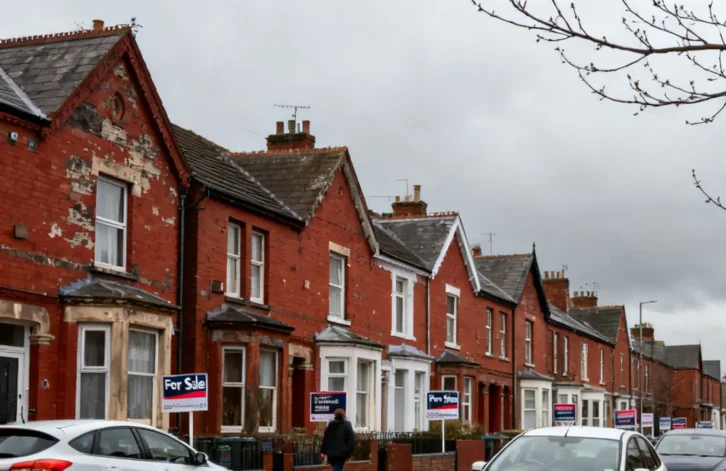
The UK housing market remained subdued in April as elevated mortgage costs and economic uncertainty continued to dampen buyer activity, according to the latest Residential Market Survey from the Royal Institution of Chartered Surveyors (RICS).
Buyer demand remained in negative territory during the month, with new buyer enquiries recording a net balance of -34%, compared with -40% in March. Agreed sales also remained weak at -36%, according to the survey of chartered surveyors.
Regional price variations
House prices came under increased pressure during April, with the headline RICS house price balance falling to -34%, down from -25% the previous month. Surveyors reported the sharpest weakness in London, the South East, East Anglia and the South West. In contrast, parts of the North West, the North of England, Scotland and Northern Ireland continued to record more resilient pricing trends.
The regional divergence highlights the affordability challenges facing buyers in southern England, where property prices remain significantly higher relative to local incomes. This comes as recent data shows 44% of UK homes listed for sale fail to find buyers, indicating broader market challenges.
Market outlook remains cautious
Surveyors reported a cautious outlook for the months ahead. Short-term sales expectations remained negative at -32%, while the twelve-month outlook slipped slightly below neutral, suggesting many agents expect market conditions to remain flat for much of the year.
Supply levels showed little movement overall, although new appraisals fell back into negative territory, indicating fewer homeowners may be preparing to come to market. Despite the weaker near-term picture, twelve-month price expectations remained marginally positive, although at their weakest level since late 2023.
Lettings market pressures persist
The lettings market continued to face a supply-demand imbalance. Tenant demand increased during April, while landlord instructions remained in decline, reinforcing ongoing pressure on rental stock levels. A net balance of respondents expects rents to continue rising over the coming months, adding to concerns about affordability for private tenants who already spend 36% of income on rent.
Tarrant Parsons, RICS head of market research and analysis, said: “April’s results show a housing market still in the grip of macro headwinds stemming from the Middle East conflict. Recent warnings from the Bank of England that interest rate rises may be required to tackle renewed inflation, driven by elevated oil prices and disrupted supply chains, underline the challenging environment facing buyers.”
He added: “Until there is a clearer path for inflation and borrowing costs, activity and sentiment look set to remain subdued, particularly across southern England and London where affordability pressures are most acute.”
Implications for investors
The data suggests property investors may face continued market uncertainty in the near term, with transaction volumes likely to remain below historical averages. The regional price variations indicate potential opportunities in northern markets, where pricing has proven more resilient, while southern markets may face extended periods of price adjustment.