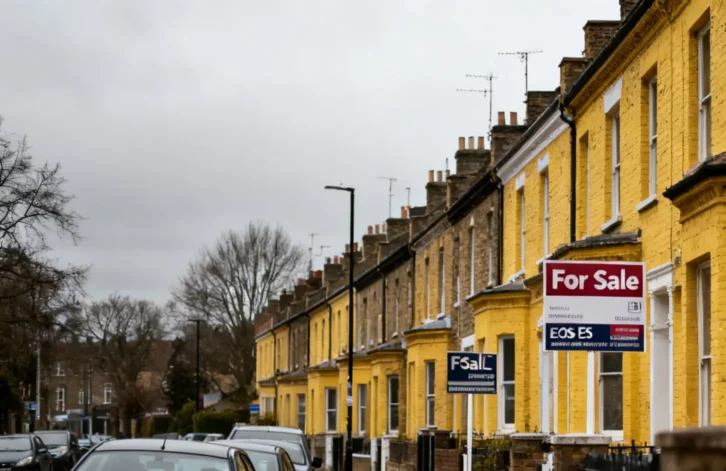
The UK housing market has continued to soften, with sales agreed down 7% year-on-year and buyer demand falling 15%, according to the latest Zoopla House Price Index. The data reveals that three in five homes listed for sale since January remain unsold, as higher mortgage rates and political uncertainty weigh on market activity.
House price growth has slowed to 1.4% nationally, with regional variations showing values declining in London whilst rising across much of northern England. The figures point to a market where transactions are taking longer to complete and buyers are adopting a more cautious approach.
Market conditions and affordability pressures
Jeremy Leaf, a north London estate agent, noted that excess property supply across various price ranges, combined with uncertainty about the protracted war in Iran and its economic impact, is affecting homebuyer and seller confidence. He added that sales are taking longer to agree and generating commitment has become increasingly difficult, though the majority of agreed sales are still proceeding.
Marc von Grundherr, director of Benham and Reeves, identified affordability as the defining force in today’s market. “Higher mortgage costs, coupled with already elevated purchase prices, mean buyers are taking longer to commit and becoming far more discerning,” he said, noting that London is experiencing the greatest impact.
The findings align with recent shifts in buyer preferences, as purchasers become more selective about property condition and pricing.
Regional variations persist
Nathan Emerson, CEO of Propertymark, emphasised that there is no single national housing market, with conditions varying considerably between areas. “Property professionals are continuing to see healthy levels of enquiries and viewings, but many buyers are taking longer to commit and are carrying out more research before making an offer,” he said.
Tom Bill, head of UK residential research at Knight Frank, warned that a summer of tax speculation could stifle demand for the second consecutive year. He noted that after the seasonal spring bounce was cut short by higher mortgage costs arising from the Middle East conflict, buyers and sellers may not get a chance to recover.
Pricing strategy becomes critical
Multiple industry figures stressed the importance of realistic pricing in the current environment. Verona Frankish, CEO of Yopa, stated that sellers need to recognise that pricing correctly from day one is more important than ever, with overpricing likely to result in properties sitting on the market whilst better-priced homes secure buyers.
Chris Hodgkinson, managing director of House Buyer Bureau, noted that whilst market conditions have become more challenging, the situation is far from the freeze witnessed after the 2022 mini-budget. “Buyers are still active, but they’re taking a far more measured approach and won’t be rushed into paying over the odds,” he said.
Nigel Bishop of buying agency Recoco Property Search added that with interest rates remaining at 3.75%, the market is unlikely to see a spike in buyer activity soon, particularly amongst those not in a rush to move.
The data suggests the UK housing market has entered a period of adjustment, with affordability constraints and economic uncertainty creating a more measured pace of transactions. The divergence between London’s declining values and growth in northern England indicates that regional price disparities continue to widen, presenting different opportunities and challenges across the country.