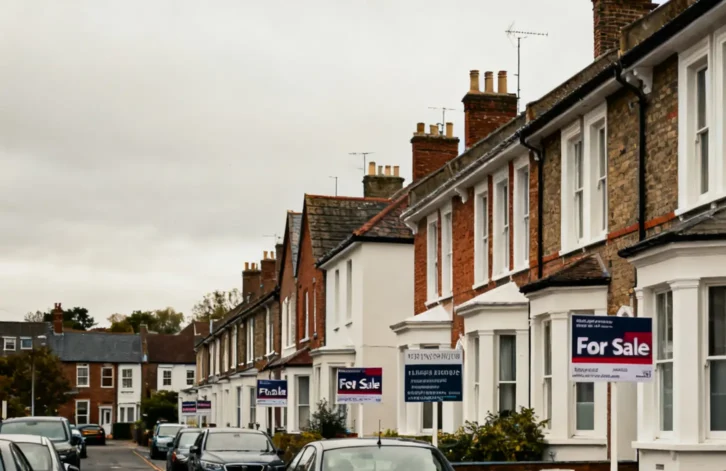
New property listings in Great Britain rose 2.6% to 209,941 in July 2026, outpacing a 1.1% increase in sales agreed, according to Sprift’s latest Sales Market Intelligence Report. The divergence pushed the national conversion rate down 0.8 percentage points to 54.6%.
The data reflects continued pressure on the housing market as mortgage costs climbed despite the Bank of England holding interest rates steady. Two-year fixed rates reached 5.62% in July, up from 4.83% in February, while consumer confidence remained negative at -17.
Regional performance gap widens
Scotland recorded the highest conversion rate at 77.0%, followed by Yorkshire and the Humber at 64.5% and Wales at 62.8%. London registered the lowest rate at 39.4%, creating a 37.6 percentage point gap with Scotland, the widest recorded between any two regions this year.
The capital’s weak performance contrasts with recent activity in the prime London market, which has shown signs of resilience in certain segments.
Six of the 11 regions converted above the national average, with the West Midlands, North East and North West also outperforming. In Scotland, properties falling through are priced above the average new instruction price at £259,851 against £254,974, indicating buyers are paying above asking prices to secure stock.
Stock levels and price reductions
Nationally, 95,380 listings remained unconverted in July, with nearly 40% carrying price reductions. Price reductions affected 31.3% of stock overall, down slightly from 31.8% in June.
The South East recorded the highest reduction rate at 43.6% of listings, while Scotland’s 21.5% was the lowest. The South East also holds the largest unconverted backlog at 17,637 properties, more than six times Scotland’s 2,559.
Total stock for sale across Great Britain stands at 748,652 properties, with an average time on market of 155 days. The challenging conditions come as family support for property purchases increases, with parental contributions playing a growing role in transactions.
Planning applications surge
Planning applications rose 56.2% to 19,682 in July, though the approval rate eased slightly to 85.0% of decided applications as refusals grew faster than approvals. Consents granted typically become completions in two to three years, suggesting potential supply improvements in the medium term.
Matt Gilpin, Founder and CEO at Sprift, said: “July is another reminder that there really is no such thing as ‘the UK housing market’. Scotland is converting 77% of new listings. London is converting just 39%. Across Great Britain, new supply grew faster than sales agreed, leaving more than 95,000 July listings still searching for a buyer.”
The widening regional divide and rising unconverted stock levels suggest agents will face increased competition for valuations as the market enters the autumn period, with pricing strategy becoming increasingly important in areas with higher stock levels.