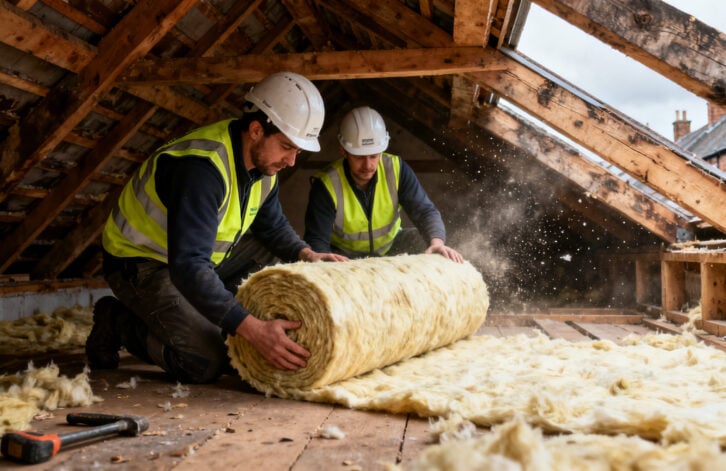
A thinktank has proposed that English councils establish their own workforces to install home insulation, moving away from the current reliance on private contractors that has resulted in widespread quality issues.
Common Wealth, in a report released this week, recommends creating ‘home improvement corporations’ that would allow councils greater control over retrofitting work under the government’s £15bn warm homes plan, announced in January.
Current scheme performance
The proposal comes after significant problems with existing insulation programmes. The National Audit Office found in 2024 that 98% of homes fitted with external wall insulation under the Energy Company Obligation (ECO) and Great British Insulation Scheme required repairs. More than a quarter of homes with internal insulation also needed remediation.
In January, the public accounts select committee called for a Serious Fraud Office investigation into what it termed a ‘catastrophic failure’ of the schemes.
Current funding allocation has also been limited in scope. The Warmer Homes consortium, led by Portsmouth city council, received £22m distributed among 31 authorities over three years, translating to approximately 15-20 homes per local authority annually.
Proposed model
The report suggests councils train and permanently employ workers from the estimated 140,000 people needed for insulation installation. This workforce would operate on a street-by-street basis using an opt-out system, where residents would need to explicitly reject upgrades rather than apply for them.
Common Wealth proposes 30 home improvement corporations covering England, prioritising deprived areas and combining insulation work with repair operations where properties require maintenance.
Madeleine Pauker, the report’s lead author, stated: ‘The current model is not capable of delivering that level of increase in the number of skilled workers. It has to be led by the public sector.’
Industry response
Christopher Hammond, chief executive of UK100, a network of local authorities pursuing climate goals, cited Leeds’ Holbeck district as an example where council-led street-by-street improvements achieved 90% resident uptake.
Hammond noted that home improvement corporations were not the only solution, stating: ‘The simplest way to do that is by giving local leaders the long-term, non-competitive resources they need.’
The Department for Energy Security and Net Zero said the warm homes plan ‘could upgrade entire streets of social homes at once’ and that a new Warm Homes Agency would ‘transform people’s experience of home upgrades, including providing initial advice to ensure consumers have confidence in accessing quality installations.’
Market implications
The shift from private contractors to council-employed workforces could reshape the home improvement sector, potentially reducing opportunities for private firms while addressing quality control issues that have plagued recent schemes. The proposal also aims to create a permanent skilled workforce beyond the three-year warm homes plan timeframe.
The warm homes plan targets improved insulation, heat pump installation, and solar panel fitting across England’s housing stock, with the dual objectives of reducing energy bills and lowering greenhouse gas emissions.