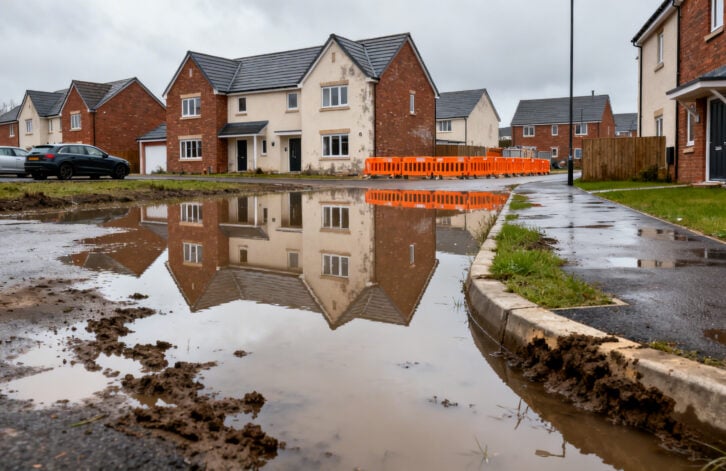
Analysis of new housing data shows that 43,937 homes built in England between 2022 and 2024 are located in areas classified as medium or high flood risk, representing one in nine of all new properties constructed during this period.
The figures, published by insurer Aviva, indicate an increase from previous years. Between 2013 and 2022, one in 13 new homes were built in potential flooding zones. Of the 396,602 new homes recorded by the Ordnance Survey during the two-year period, 26% face some level of flood risk.
Regional distribution
Greater London and Essex account for the highest proportion of new at-risk properties at 32%, followed by Lincolnshire, East Yorkshire, the west and north-west at 13%. The east of England recorded the lowest proportion at 2%.
The analysis cross-references new homes address data with the Environment Agency’s latest flood risk assessment at constituency level.
Future projections
Aviva’s data suggests that by 2050, 15% of homes built between 2022 and 2024 will be at medium or high risk of flooding, with 30% facing some kind of flood risk. The projections factor in anticipated extreme rainfall patterns.
Emma Howard Boyd, former chair of the Environment Agency and climate policy adviser to Aviva, said: “We don’t want to be building today’s houses in places where they will become ever more at risk of flooding. Defra and the Ministry for Housing need to be working close together to make sure our housing targets aren’t preventing what we know is needed to protect future and existing homes from future levels of flooding.”
Insurance implications
Properties built after 2009 are excluded from the government-backed Flood Re reinsurance scheme, which provides affordable flood insurance for homeowners. This exclusion affects all homes in the study period.
Jason Storah, chief executive of UK and Ireland general insurance at Aviva, said: “As our analysis shows, too many new homes have been built in higher risk areas. It’s particularly worrying that this trend has risen in recent years, just as housebuilding accelerates.”
The Association of British Insurers reported that domestic flood claims costs rose 38% in 2025 to £312m, with average payouts to homeowners reaching £30,000, a 60% increase. Total weather-related property claims reached £1.2bn, up 14% year-on-year.
Chris Bose, director of general insurance policy at the ABI, said: “Government action is essential to protect communities from the growing impact of extreme weather. This includes stronger planning rules to stop building in high-risk flood areas and designing homes with resilience in mind.”
Government response
A government spokesperson disputed aspects of the analysis, stating: “These figures are misleading as the research doesn’t even factor in flood defences in place. We will build 1.5m homes without compromising on safety, and our planning proposals will ensure that development should not go ahead where it would be unsafe due to flood risk.”
Aviva contested this claim, stating that flood defences are included in their assessment.
The government announced £10.5bn investment for flood projects, which it states will benefit nearly 900,000 properties by 2036.
The data emerges as the government pursues a target to deliver 1.5m new homes during the current parliament, raising questions about the balance between housing supply targets and flood risk management in planning decisions.