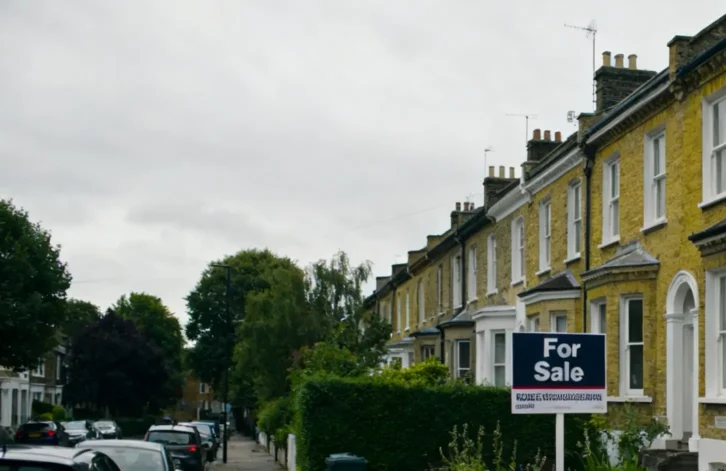
UK house prices remained broadly flat in July as higher mortgage rates and stretched affordability continued to constrain buyer activity, according to Lloyds Banking Group’s monthly index.
The average property price stood at £299,253 in July, down £143 from June. Annual growth registered just 0.1%, marking the weakest rate since November 2023, the lender reported.
Amanda Bryden, head of mortgages at Lloyds, noted that prospective buyers faced affordability challenges, particularly as Middle East tensions prompted mortgage rate increases. “While housing demand remains broadly steady, activity continues to respond quickly to changes in mortgage rates,” she said.
The average two-year fixed residential mortgage rate reached 5.63% on Friday, according to Moneyfacts, with five-year deals at 5.67%. Both rates stood below 5% at the start of 2026.
Regional performance diverges
Northern Ireland recorded the strongest growth across the UK, with prices rising 7.4% year-on-year to an average of £231,131. Scotland saw prices increase 3.6% to £223,246, while Wales registered 1.6% growth with average values at £231,458.
In England, the north-east led with 2.8% annual growth, bringing the average to £182,488. The north-west recorded 2.1% growth to £247,836. By contrast, the south-east experienced a 2% decline to £381,146, while Greater London prices fell 1.3% to £533,930.
Anthony Codling, analyst at RBC Capital Markets, described the market as being in “suspended animation”, with prices trapped in a narrow two-year range by stretched affordability and persistently elevated mortgage rates. “The market is not in crisis, but the green shoots that flickered briefly in early 2026 have wilted,” he said.
Nicholas Finn, managing director at Garrington Property Finders, said the north-south property divide was “becoming more entrenched”. He attributed southern weakness to excess supply attracting insufficient buyers, while northern markets benefited from more balanced supply-demand dynamics and sentiment surrounding the government’s No 10 North initiative.
Market outlook remains uncertain
Lloyds expects market activity and house prices to remain relatively stable through the remainder of the year, with developments dependent on how mortgage rates respond to inflation expectations and broader household confidence.
The data reflects challenges facing the UK property market as it navigates elevated borrowing costs and economic uncertainty. Rising tensions in the Middle East have stoked inflation concerns, feeding expectations of potential interest rate movements that could further impact mortgage availability and pricing.
The stagnation in house price growth suggests the market remains in a holding pattern, with neither buyers nor sellers willing to make significant moves until greater clarity emerges on the trajectory of mortgage rates and the broader economic outlook.