This content is a sponsored publication provided by Compass Pools, an award-winning business specialising in luxury swimming pool design, building and installation.
For much of the past decade, the question of whether a swimming pool adds value to a UK property has drawn the same cautious answer from agents and surveyors alike: it depends. Maintenance costs, limited usability during colder months, and the sheer footprint required have all made traditional pools a hard sell in the UK market.
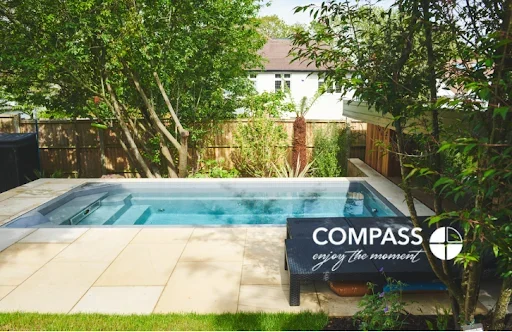
But a shift is underway, and it is not coming from luxury developers building full-size lap pools. It is coming from a quieter corner of the market: the compact, in-ground swim spa system designed for year-round use in a fraction of the space.
Here, Compass Pools explains how year-round usability affects buyer psychology, time-on-market, and perceived build quality, and why the smartest developers are treating leisure amenities as part of the core build specification.
The traditional seasonality problem
The conventional outdoor pool carries a perception problem in the UK that goes beyond maintenance. Buyers looking at a 10-metre swimming pool in a garden calculate, consciously or otherwise, how many months per year it will actually be used. For much of the country, that number is low. The result is a feature that occupies significant space, adds to ongoing running costs, and appeals to a narrower buyer demographic than almost any other premium garden feature.
Swim spas work from a different premise. Smaller in footprint, requiring less excavation, and engineered to maintain water temperature efficiently across seasons, they reframe the question from “do you want a pool?” to “do you want a usable outdoor wellness space all year round?” That is a materially different conversation with a wider buyer profile.
What buyer psychology says about year-round usability
Properties positioned as offering lifestyle assets rather than decorative garden features attract a different level of buyer engagement. This distinction matters to investors and developers because it helps both the speed of sale and the achievable higher price point.
A swim spa that operates year-round signals something specific about a property: it has been thought through. For the buyer segment that values wellness amenities alongside quality of build, a swim spa sits alongside a home gym or a sauna room as evidence of quality design. Crucially, unlike a full-size pool, it doesn’t raise immediate concerns about upkeep or winters spent covering a body of water that nobody is using.
This shift is particularly pronounced across the demographic groups central to new-build and prime residential markets: older buyers downsizing into well-specified properties, active buyers in their 40s and 50s, and families seeking safe contained water access. That breadth of appeal matters commercially, particularly when a developer is making specification decisions before a scheme goes to market.
The case for compact in-ground swim spas
Reduced excavation demand is one of the practical advantages driving developer interest. Full-size pools require significant groundworks that add time, cost, and complication to build programmes. A compact in-ground swim spa needs a considerably smaller footprint and shorter installation timeline, improving the economics for developers working to tight schedules.
Running costs also feature increasingly in buyer conversations. Energy-conscious buyers, particularly at the premium end, are aware that pool technology carries ongoing cost. Compact systems are engineered to be more efficient to heat and maintain than traditional pools, and that efficiency is a selling point that can be built into marketing materials rather than glossed over.
Compass Pools offers a range of compact in-ground swim spas that combine exercise functionality with spa features in a single unit. Their carbon-ceramic shell construction is designed for durability and low maintenance, while models equipped with a swim-against-current system allow serious swimmers to train in a compact space that would not accommodate a conventional lap pool.
That combination of performance and practicality is precisely what higher-specification schemes need when positioning outdoor space as genuinely functional living space rather than an optional luxury.
What this means for developers and investors right now
The market is at a point where the specification decision is still a differentiator. Developers who include swim spas now are ahead of a trend that will follow the same trajectory as underfloor heating or dedicated home offices: optional today, standard expectation within a few years.
For investors assessing existing stock, the approach is similar to any other premium feature retrofit: installation cost weighed against impact on achievable price and time-on-market. A compact swim spa does not require extensive planning permission for most residential properties, and the installation process is considerably less disruptive than a full pool build.
The broader point is that outdoor space is no longer assessed on size alone. What it can do across twelve months is increasingly the measure buyers apply. Aquatic infrastructure that meets that test, at a scale and cost that works for the typical UK garden, is a specification decision developers and investors should be making now rather than later.