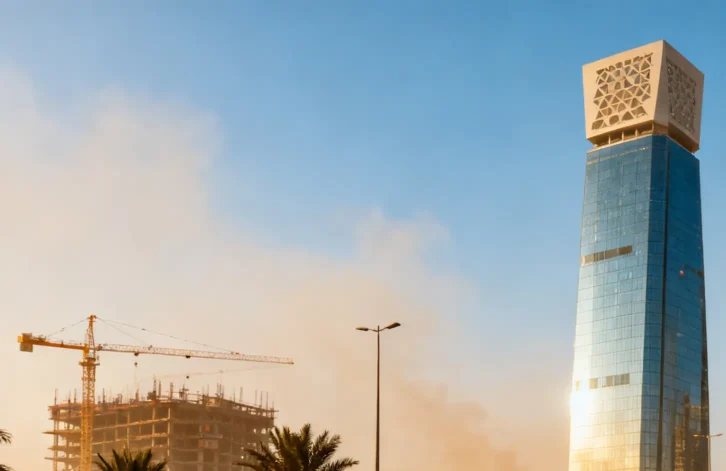
Riyadh’s property market is attracting increased attention from international investors as Saudi Arabia’s Vision 2030 transformation programme drives infrastructure development and corporate relocations to the capital.
The city’s real estate sector is being reshaped by several concurrent factors, including government-backed megaprojects, headquarters relocations by multinational companies, and preparations for hosting Expo 2030 and the 2034 World Cup.
Market fundamentals
Unlike other Gulf cities that rely heavily on external demand, Riyadh benefits from a substantial domestic buyer base. The city’s property market is supported by a large Saudi population, significant household wealth, and an expanding government and corporate employment sector.
Key districts attracting investment include Diriyah, which is undergoing state-backed regeneration, and areas surrounding the King Abdullah Financial District (KAFD), where demand for executive housing is rising. North Riyadh is also seeing development activity driven by infrastructure expansion.
The Wadi Safar district within Diriyah is positioned at the upper end of the market, targeting high-net-worth buyers seeking trophy villas and family compounds.
Investment considerations
Market observers note differences between Riyadh and Dubai’s property markets. Riyadh shows stronger domestic demand but lower international brand recognition compared to Dubai’s established market. Infrastructure momentum in Riyadh is described as extremely strong, though the market remains at an earlier stage of development.
Off-plan properties in Riyadh offer lower entry pricing and payment plans, whilst completed properties provide immediate rental income opportunities. The choice between villas and apartments depends on investment strategy, with villas offering potential land appreciation and apartments providing lower entry costs and rental yields.
Rental demand is expected to strengthen in premium apartments near business hubs and modern family villas as corporate relocations continue. The government’s requirement for international companies seeking contracts to establish regional headquarters in Saudi Arabia is driving executive housing demand.
Market risks
Industry analysts highlight several considerations for investors. Some market segments face potential oversupply, whilst off-plan project execution quality varies between developers. Liquidity differs significantly by asset type, and optimal returns typically require medium to long-term holding periods.
The market’s development trajectory between 2026 and 2030 will be influenced by the pace of corporate relocations, infrastructure delivery, and the materialisation of announced megaprojects. By 2030, the market is expected to show greater differentiation between prime and standard stock.
Foreign investors are advised to focus on prime districts with limited supply, branded developments, and projects with clear scarcity value. Understanding exit liquidity and identifying future buyer profiles are considered essential due diligence steps.
The transformation of Riyadh’s property market reflects broader economic diversification efforts under Vision 2030, though the extent to which development plans translate into sustained market growth remains to be tested over the coming years. As with housing delivery challenges elsewhere, execution risk remains a factor in ambitious development programmes.