The question every property owner should ask themselves is not whether they can afford to invest in modern fire safety systems, but whether they can afford not to. In an era where building regulations are tightening and the consequences of non-compliance have never been more severe, understanding how contemporary safety technologies function has shifted from a matter of professional interest to an essential responsibility. Whether you manage a commercial property, own a rental portfolio, or simply want to protect your family home, the systems available today offer protection that extends far beyond the basic smoke detector mounted on a hallway ceiling.
The Regulatory Landscape Driving Change
The foundation of fire safety law in England and Wales remains the Regulatory Reform (Fire Safety) Order 2005, which places legal duties on the “responsible person”—typically the building owner, employer, or managing agent—to ensure a suitable and sufficient fire risk assessment is in place and kept current. Layered on top of this are more recent legislative developments that have fundamentally reshaped what compliance looks like in 2026.
The Fire Safety Act 2021 clarified that the Order applies to the structure, external walls, and flat entrance doors in multi-occupied residential buildings. The Building Safety Act 2022 introduced the Building Safety Regulator and placed new accountability duties on building owners, particularly for higher-risk buildings over 18 metres or seven storeys. Meanwhile, the Fire Safety (England) Regulations 2022 introduced specific duties including quarterly and annual fire door checks and mandatory fire safety information sharing with Fire and Rescue Services. From 6 April 2026, the Fire Safety (Residential Evacuation Plans) (England) Regulations 2025 came into force, requiring responsible persons to identify residents who may need assistance evacuating and to agree written Personal Emergency Evacuation Plans with those who request them.
What this regulatory evolution makes clear is that fire safety is no longer treated as a static installation to be forgotten after commissioning. It is a living system that demands ongoing attention, documentation, and adaptation. The systems themselves have evolved to meet these heightened expectations.
Intelligent Detection: Beyond Basic Alarms
Modern fire alarm systems bear little resemblance to the simple bells and buzzers of previous decades. Today’s installations incorporate addressable technology, where each detector, call point, and sounder carries a unique identifier. When an alarm triggers, the control panel pinpoints the exact device and location, enabling faster, more targeted responses. This is particularly valuable in large or complex buildings where knowing precisely where a fire has started can mean the difference between a contained incident and a catastrophic spread.
The updated British Standard BS 5839-1:2025, which came into effect in April 2025, has introduced clearer guidance on system categories and detector requirements. Smoke detectors are now the preferred type for sleeping areas such as care homes, student housing, and hotels, with the use of heat detectors only advised where justified by a fire risk assessment. The standard also places greater emphasis on visual alarm devices for deaf or hard-of-hearing occupants, reflecting a broader commitment to inclusive safety design. For category L systems, fire signals must reach alarm receiving centres within 90 seconds, and faults within three minutes—a performance benchmark that legacy systems often struggle to meet.
The shift toward intelligent detection is not merely about speed. It is about accuracy. False alarms drain emergency response resources, desensitise building occupants, and can lead to systems being deliberately disabled. Modern multi-sensor detectors analyse multiple indicators—smoke, heat, and carbon monoxide—to distinguish between genuine fire conditions and benign events such as burnt toast or steam from a shower. This reduction in false alarms keeps systems operational and trusted, which is arguably more important than the technology itself.
Integration and Remote Monitoring
One of the most significant developments in recent years has been the integration of fire safety systems with broader building management platforms. Rather than operating in isolation, modern fire alarms can communicate with access control systems, automatically unlocking doors along evacuation routes; with HVAC systems, shutting down air handling to prevent smoke circulation; and with public address systems, delivering clear voice evacuation instructions rather than indistinguishable sirens. In buildings with phased evacuation strategies, this integration allows different zones to receive tailored instructions—stay put, evacuate, or await assistance—based on real-time information about the fire’s location and spread.
Remote monitoring has also transformed how unoccupied buildings are protected. When a fire alarm triggers in an empty office block at 2 a.m., a monitored system ensures the signal reaches an alarm receiving centre and, if verified, the fire service within minutes. For businesses, this means protection continues around the clock without requiring staff presence. For insurers, it represents a measurable reduction in risk, often reflected in premium calculations. The 2025 update to BS 5839-1 now requires that control panels connected to emergency services display a false alarm notice, designed to discourage misuse and reduce unnecessary callouts—a small but telling detail that illustrates how standards evolve in response to operational realities.
Residential Applications: Protecting Where We Live
While much of the regulatory focus has fallen on commercial and high-rise residential properties, the principles of modern fire safety apply equally to private homes. The Fire Safety Act 2021 and subsequent regulations have clarified that landlords cannot treat structural elements as outside their fire safety obligations. In multi-occupied residential buildings, interlinked smoke and heat alarms are increasingly mandated, ensuring that if a fire starts in a ground-floor kitchen, residents on the top floor are alerted simultaneously rather than relying on smoke to travel through closed doors and stairwells.
For homeowners, the case for modernisation is equally compelling. Battery-powered standalone alarms, while better than nothing, lack the reliability of mains-powered systems with battery backup. Wireless interlinked systems, which meet BS 5839-6 for domestic premises, can be installed with minimal disruption and provide whole-house coverage. In properties with vulnerable occupants—older residents, young children, or those with mobility limitations—the ability to receive early warning and clear evacuation guidance can be genuinely life-saving.
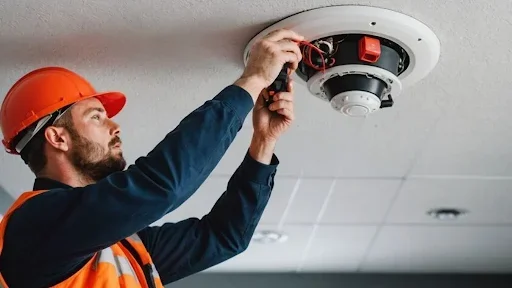
Property owners in the capital looking to bring their buildings up to current standards should consider arranging a professional fire alarm installation in London to ensure their systems meet the latest BS 5839-1:2025 requirements and are configured correctly for their specific building layout and occupancy profile.
The Competency Imperative
Perhaps the most important change introduced by BS 5839-1:2025 is the formal definition of a competent person as someone “suitably trained and qualified by knowledge and practical experience, and provided with the necessary instructions, to enable the required task(s) to be carried out correctly.” The standard explicitly notes that maintaining competence is likely to require continuing professional development.
This matters because a fire alarm system is only as reliable as its installation and maintenance. A poorly positioned detector, a misconfigured control panel, or a neglected annual service can render even the most advanced technology ineffective. Building owners and managers should verify that any contractor they engage holds recognised third-party certification, such as BAFE SP203-1 or LPS 1014, and that engineers are familiar with the 2025 standard’s requirements. Documentation—design certificates, commissioning records, zone plans, and maintenance logbooks—is not bureaucratic box-ticking. It is the evidence chain that demonstrates compliance and, in the event of an incident, proves that reasonable steps were taken to protect occupants.
The UK government’s official fire safety guidance for responsible persons makes clear that fire safety measures must be maintained regularly and suitably, kept in an efficient state, efficient working order and good repair. This is achieved through regular inspection, testing and servicing of all fire safety systems and equipment, with defects repaired as soon as practicable.
Looking Forward: A Culture of Prevention
The trajectory of fire safety regulation and technology points toward a culture of prevention rather than reaction. The Building Safety Regulator’s oversight of higher-risk buildings, the mandatory golden thread of building information, and the emphasis on personal emergency evacuation plans all signal a shift toward proactive, person-centred safety. Modern systems support this shift by providing data—on detector sensitivity trends, battery health, maintenance intervals, and incident response times—that enables continuous improvement rather than periodic compliance checks.
For property owners considering how to meet these evolving standards, professional assessment is the logical starting point. A thorough fire risk assessment, conducted by a competent person, will identify the specific hazards present in a building and recommend appropriate detection and alarm coverage. In many cases, upgrading an existing system to meet current standards is more cost-effective than facing enforcement action or, worse, dealing with the aftermath of a preventable fire.
Ultimately, modern safety systems do not replace human vigilance or sound judgement. They augment them. They provide the early warning, the clear communication, and the automated responses that buy precious time when seconds matter. In a regulatory environment where the duties of building owners have never been more clearly defined—or more rigorously enforced—investing in up-to-date fire detection and alarm technology is not merely a legal obligation. It is a moral one.