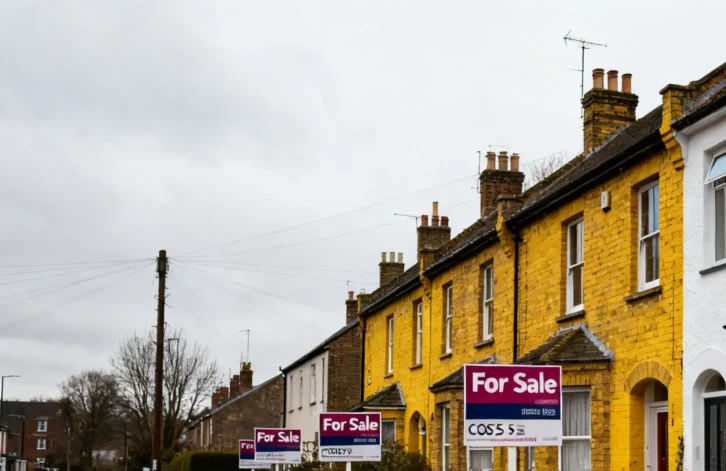
UK mortgage approvals for house purchases declined to 56,100 in July, down from 58,200 in June, according to Bank of England data released today. The 3.7% monthly decrease represents a 15% year-on-year fall and sits 7.3% below the five-year average.
The July figure marks a reversal of June’s uptick, which had prompted speculation about a potential market recovery. Net borrowing of mortgage debt by individuals decreased to £4.3 billion in July from £7.7 billion in June, below the previous six-month average of £5.3 billion.
The effective interest rate on newly drawn mortgages increased to 4.45% in July from 4.35% the previous month. The rate on the outstanding stock of mortgages rose marginally to 3.97% from 3.96%. Approvals for remortgaging increased slightly to 34,500 from 34,100.
Market implications
Anthony Codling, Managing Director of Equity Research at RBC Capital Markets, described the data as “a pebble in the shoe for housebuilders who had been cautiously optimistic that demand momentum would hold through the summer.” He noted the figure sits 13% below the ten-year average, adding that “weak data may spur the Government on to stimulate the housing market in next month’s budget.”
Jason Tebb, President at OnTheMarket, stated that “approvals for house purchases, a more useful measure of market activity than prices as they indicate future borrowing, fell in July and remain below the previous six-month average as ongoing political and economic uncertainty impacts buyer and seller decision-making.”
The decline follows recent data showing UK house prices rising 0.2% in August, suggesting mixed signals in the housing market.
Industry concerns
Gareth Lewis, Deputy Chief Executive of MT Finance, said: “Earlier this year, approval numbers were picking up quite nicely, before dipping in May and now falling again. We are seeing the ramifications of the unstable interest rate environment and the impact this has on transactions.” He called for “urgent stimulus for the housing market” to encourage transactions and benefit the wider economy.
Hina Bhudia, Partner at Knight Frank Finance, attributed the decline to geopolitical tensions and elevated energy prices pushing mortgage rates higher during the summer. “Leading fixed rates have been broadly stable in recent weeks, with two-year fixed rates as low as 4.45%, but we’d need to see those rates fall closer to four before a more sustained recovery takes hold,” she said.
Jeremy Leaf, a north London estate agent and former RICS residential chairman, noted that while enquiries are “increasing slowly and certainly better than a few months ago,” they are “not nearly at the same pace as this time last year.” He added that “approvals are a good indicator of activity over the next three months at least and these suggest buyers and sellers are cautious about prospects while economic and political factors remain so uncertain.”
Budget uncertainty
Nathan Emerson, Chief Executive of Propertymark, suggested that “many people may be holding back on major housing decisions until there is greater economic clarity” ahead of the Autumn Budget. Bhudia echoed this concern, stating that “speculation ahead of the Budget presents another risk” and noting that “in previous years, reports of potential changes to property taxation have prompted buyers to put plans on hold.”
Nick Leeming, Chairman of Jackson-Stops, characterised the fall as reflecting “volatility in mortgage pricing seen during July, as changing inflation and interest-rate expectations affected the confidence and affordability calculations of some buyers.” However, he noted that Jackson-Stops research found 8% of owner-occupiers in England are planning to move or are already doing so, “demonstrating a meaningful pool of underlying demand.”
The mortgage approval data comes at a time when alternative lending products continue to see activity, suggesting some segments of the property finance market remain active despite broader headwinds.
The figures indicate that the housing market faces continued challenges heading into autumn, with mortgage costs, economic uncertainty, and upcoming fiscal policy changes weighing on buyer sentiment. Industry observers will be monitoring whether the government introduces housing market stimulus measures in the October Budget.