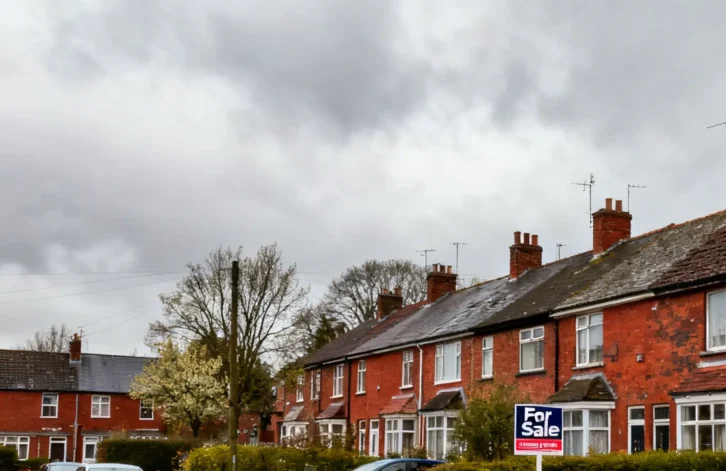
UK house prices declined for the second consecutive month in April, according to Halifax, as mortgage rates climbed and uncertainty over interest rate trajectories dampened buyer activity.
The mortgage lender, part of Lloyds Banking Group, reported that the average UK home price fell 0.1% in April to £299,313, following a 0.5% decline in March. The annual rate of house price growth slowed to 0.4%, down from 0.8% previously.
Mortgage rates climb sharply
The slowdown follows a significant increase in borrowing costs. According to Moneyfacts, the average two-year fixed mortgage rate stood at 5.77% on Thursday, up from 4.83% at the start of March. Five-year fixed rates rose to 5.69% from 4.95% over the same period.
Amanda Bryden, head of mortgages at Halifax, said: “After a strong start to the year, recent global developments have added a greater degree of uncertainty to the outlook. In particular, higher energy prices have fed into inflation expectations, prompting markets to reassess the path for interest rates – a shift that has already pushed up borrowing costs for many buyers.”
The rising cost of borrowing marks a reversal from earlier in the year, when the market showed stronger momentum. Halifax recorded monthly increases of 0.8% in January and 0.3% in February, leading the lender to forecast 1.2% annual growth in February.
Pricing disconnect emerges
Chris Hodgkinson, managing director of House Buyer Bureau, highlighted a growing gap between seller expectations and market conditions. “The problem facing the market at the moment is that many sellers are still pricing based on expectation rather than current market reality and that’s creating a growing disconnect between buyers and sellers,” he said.
“Whilst demand is still there, buyers are far more price sensitive in the current climate and homes that aren’t positioned correctly from day one are simply sitting on the market for longer, forcing sellers into larger reductions further down the line.”
The market uncertainty has also affected landlords, with tenanted property auction sales jumping 70% as landlords exit the sector amid regulatory pressures and rising costs.
Conflicting data from rival lenders
The Halifax figures contrast with data from Nationwide, which reported last week that house prices rose 3% annually in April, up from 2.2% in March. The building society recorded a 0.4% monthly increase, making the typical UK property worth £278,880 according to its data.
Nationwide has recorded four consecutive months of price increases, whilst Halifax has now reported two consecutive monthly declines. The lenders measure housing market activity using different methodologies, which can produce varying results.
The divergence in data highlights the current volatility in the market, as buyers and sellers navigate uncertainty around interest rates and broader economic conditions. Market participants are also monitoring developments in the rental sector, including capacity concerns in the tribunal system over rent appeals.
Outlook remains uncertain
The housing market faces continued uncertainty as inflation expectations and geopolitical tensions influence the Bank of England’s interest rate decisions. Higher borrowing costs have already dampened buyer sentiment, with households reconsidering planned property moves amid cost of living pressures.
The market’s trajectory in the coming months will likely depend on the path of mortgage rates and whether buyer confidence stabilises as economic conditions become clearer.