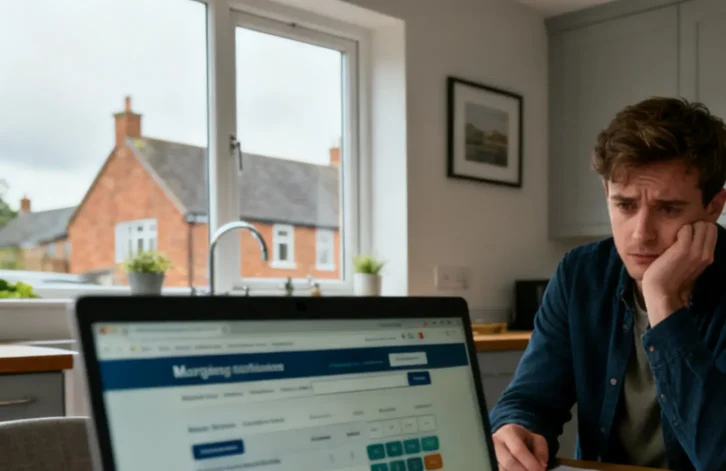
Online mortgage calculators may provide inaccurate borrowing estimates for prospective homebuyers, according to mortgage brokers who have highlighted the tools’ limitations in assessing individual circumstances.
The calculators, which allow users to estimate borrowing capacity or monthly repayments, frequently fail to account for complex income sources and financial commitments, potentially misleading first-time buyers about their actual borrowing power.
Income complexity not captured
Richard Davidson, a mortgage adviser at onlinemortgageadvisor.co.uk, explained that whilst calculators perform adequately for straightforward cases using simple income multiples, they struggle with non-standard situations.
“For a straightforward case, online mortgage calculators do a reasonable job, because most are simply applying an income multiple and showing you the maximum,” Davidson told the Newspage agency. “Where they fall down is anything outside the norm, such as self-employed income, bonuses, overtime or a household with childcare costs and car finance.”
Davidson noted that the error often results in underestimating borrowing capacity rather than overestimating it, as some lenders now offer more than 4.5 times salary for suitable borrowers. This contrasts with the standard multiples typically used by generic calculators.
Lender variations not reflected
Craig Fish, director at Lodestone Mortgages, emphasised that calculators serve only as a starting point. “Part of the problem is that people are entering the figures themselves, without knowing the rules on allowable income, which vary from lender to lender,” he said.
Fish explained that bonuses, commission, overtime and self-employed income receive different treatment across lenders, whilst outgoings, credit commitments and dependants also influence lending decisions in ways generic calculators cannot capture.
The mortgage sector has seen specialist lenders increasingly accommodate complex cases that mainstream calculators might underestimate.
Ranald Mitchell, director at Charwin Mortgages, warned that calculators should not “create false hope and leave the broker to deliver the bad news later,” adding that they should provide credible initial guidance.
Doug Miller, director at Bath-based Lansdown Financial Services, reported regularly encountering clients who have received calculator estimates that differ from actual lending capacity. In the Bath market, where property development activity continues, accurate borrowing assessments remain particularly important for buyers.
Broker assessment recommended
The brokers interviewed agreed that whilst online calculators provide useful preliminary guidance, prospective buyers should consult mortgage advisers for accurate assessments. Only lenders’ own calculators, accessed through whole-of-market brokers, can provide definitive borrowing figures tailored to individual circumstances.
The findings suggest that buyers relying solely on online tools may either underestimate their purchasing power or, less commonly, overestimate their borrowing capacity, potentially affecting property search strategies and purchase decisions.