The increasing popularity of AI technologies for completing work and school assignments is causing a new question to emerge regarding literature: how can we determine whether a piece of literature was written by an AI or a human?
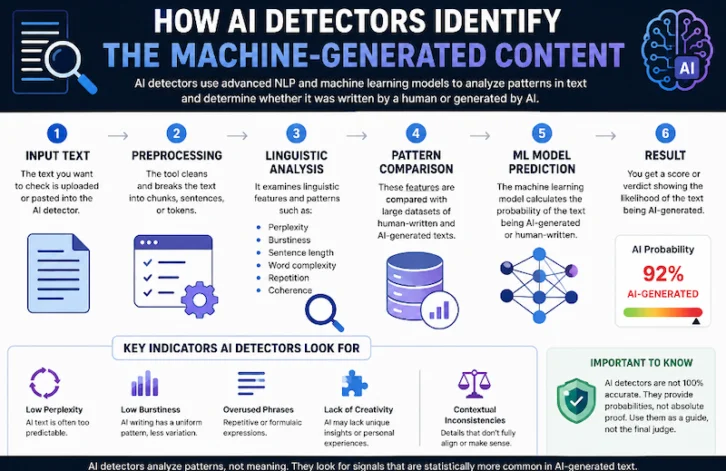
These AI detectors were created to help answer this question. They examine the text of the article and look for any indicators of whether an AI may have participated in its creation. Unlike the tests mentioned previously, these detectors examine various elements of the text.
Following this examination, the detector gives an approximate result about the probability that AI was utilized. It’s critical to comprehend the detecting process before putting your faith in an AI score. These technologies are not perfect and occasionally misunderstand the material, even tho they can provide insightful information.
What Does an AI Detector Look For?
An AI detector studies the language inside a text. It searches for patterns that may appear more often in AI-generated content. The tool may check several factors.
These factors can include:
- Word choice
- Sentence structure
- Sentence length
- Vocabulary
- Word predictability
- Repeated phrases
- Writing style
- Text consistency
- Sentence variation
- Common language patterns
The detector combines these signals. It then uses them to estimate the source of the text. The methods of detecting AI-written texts do not search for a secret mark within the document. Most AI-generated text does not contain any labels showing that an AI wrote the text.
The detector must study the actual language. One signal cannot prove AI use. A strong detection system needs several signals to make a useful estimate.
Perplexity and Word Predictability
Perplexity is an important concept in AI detection. The term describes how predictable the next word is based on the words that come before it. AI language models often select words that fit the context very well. They can create text that follows common language patterns.
Human writers can make less predictable choices. You may use an unusual word. You may add a personal phrase. You may also change your sentence style without following a fixed pattern. An AI detector can measure such differences. A text that contains highly predictable word choices may receive a higher AI score.
However, you should not treat predictability as proof. A person can also write simple and predictable content. Many professional articles use common words and clear sentence structures. The detector needs more evidence before it can make a stronger estimate.
Sentence Pattern Analysis
AI detectors can also examine sentence patterns. AI tools often create clear and organized sentences. Several sentences may follow a similar structure. Human writers can create more variation. You may write a short sentence and then use a longer sentence to explain an idea.
You may also change the rhythm of your writing. An AI detector can check these differences. It may measure sentence length, sentence structure, and changes across the text. The tool can then compare those patterns against known examples.
A highly consistent structure may raise the AI score. A text with more variation may receive a lower score. The result still does not prove the source. Many human writers use a consistent style. Some writers prefer short sentences and simple structures. Their work can sometimes look similar to AI content.
Vocabulary Analysis
Word choice can provide another useful signal. AI tools often use common vocabulary. They may also use formal words and familiar phrases. You may notice the same type of language across several AI-generated articles.
An AI detector can examine the vocabulary in a text. It can check how often certain words appear. The tool may also look at the relationship between different words. A text that uses highly predictable vocabulary may show patterns that match AI-generated samples.
Human writers can also use common vocabulary. That fact creates a challenge for AI detectors. A good detector should not rely on vocabulary alone. It should combine word choice with other signals.
Sentence Length and Variation
Sentence length can also affect an AI detector’s result. Human writing often contains different sentence lengths. You may write one short sentence to make a strong point. You may then use a longer sentence to explain the same idea.
AI text can sometimes show less variation. Several sentences may have a similar length and structure. AI detectors can measure sentence length across a full text. They can also check how much the structure changes from one sentence to another. The tool may use that information as part of its final score.
A steady sentence pattern does not always mean AI use. Some writers follow strict style rules. Their sentences can look very consistent. That is why detectors need more than one signal.
Repetition and Predictable Phrases
AI tools can repeat certain words and phrases. An AI article may use similar transitions in several sections. It may also explain different points in a similar way. AI detectors can search for such patterns. The tool may compare phrases across the entire text. It can also check repeated sentence structures.
Repeated language can give the detector another clue. Human writers can also repeat words. You may use the same phrase several times because it fits the topic. Repetition alone cannot prove AI use. The detector needs to compare repetition with other language patterns.
Machine Learning Models
Many AI detectors use machine learning. Developers train these systems on large amounts of text. The training data can contain human-written and AI-generated examples. The system studies the differences between those samples. It then uses what it learned to analyze new text.
Suppose you upload an article to an AI detector. The system can compare its language patterns against patterns from its training data. The detector then produces a result based on that comparison.
Training data has a major effect on performance. A detector may struggle if its data does not contain enough examples from newer AI models. Language can also affect accuracy. A tool may work better in English than in another language. The same issue can appear with different writing styles.
AI Detectors Use Multiple Signals
A strong AI detector should not depend on one feature. Word predictability can create mistakes. Sentence length can also create mistakes. The detector can check several signals at the same time.
It may examine:
- Vocabulary
- Sentence structure
- Word predictability
- Sentence length
- Repetition
- Text consistency
- Phrase patterns
- Writing style
The system combines the results. The combined data can help the detector create a stronger estimate. You should still treat the final result as an estimate. No single AI score can prove that a person used an AI tool.
Why AI Detection Is Difficult
AI detection has several challenges. Human writing can look like AI writing. A person may use simple words and short sentences. A person may also follow a very clear structure.
Such writing can look predictable. AI tools can also create natural text. Modern models can use different sentence lengths and vocabulary.
That makes the line between human and AI writing harder to identify. Human edits create another challenge. A person can take AI-generated text and change many parts of it. They can add personal details, replace words, remove phrases, and rewrite sentences.
The final text may look very different from the original AI output. An AI detector may then struggle to identify the source.
Can AI Detectors Detect Every AI Model?
No AI detector can detect every AI model with perfect accuracy. AI technology changes fast. New models can produce more natural language. They can also create more varied sentence structures.
AI detectors must keep improving as AI models improve. A detector may work well against one model. It may give weaker results against another model.
The same detector may also produce different results after an AI model receives a major update. You should check the detector’s testing data before you trust its claims.
A tool should explain its limits. It should also provide clear information about how it tests its system.
What About Human-Edited AI Content?
Human edits can make AI detection harder. Imagine that you ask an AI tool to create an article. The first draft may contain patterns that a detector can identify. You then edit the draft.
You add your own examples. You change the sentence structure. You replace common phrases. You remove sections that do not fit your style. Major edits can also change the AI score.
A text may receive a high score before edits and a lower score after edits. The opposite can also happen. Human edits do not guarantee a lower AI score.
Do AI Detectors Give a Percentage?
Many AI detectors show a percentage or probability. The score usually represents the detector’s estimate. The system creates that estimate based on the patterns it finds in the text. You should read the tool’s explanation before you judge the score. A percentage can give you a useful clue. It should not act as final proof.
You should also avoid comparing scores from different detectors as if they use the same system. Each tool can use its own method and data.
One tool may give a high score. Another tool may give a much lower score. That difference shows why context matters.
What Causes False Positive Results?
A false positive occurs when a detector labels human text as AI-generated. Several factors can cause this result. Simple writing can sometimes look predictable. Formal writing can also contain common sentence patterns.
A student who uses basic English may receive a high AI score. A professional writer may face the same issue. Short text can create another problem.
A detector has less information when you give it a small sample. The tool may then make a less reliable estimate. Language can also affect results. A detector trained mainly on English text may struggle with other languages. You should never judge a writer only from an AI detector score.
What Causes False Negative Results?
A false negative occurs when AI-generated content receives a human-written result. AI models can create natural and varied text. Human edits can also change the original patterns.
A writer may make major changes to an AI draft. The final text may then look more like human writing. A detector can miss some AI-generated content. That fact shows another limit of AI detection. The tool can provide an estimate.
How Should You Use an AI Detector?
You should use an AI detector as part of a larger review process. Start with the detector result. Then read the text yourself. Check the writing style. Look at the sources.
Source history can provide useful context. Human review remains important. An automated tool can see language patterns. A person can understand the full context.
AI Detector vs. Human Review
AI detectors can check large amounts of text quickly. Human reviewers can examine context and intent. A detector can find unusual patterns. A person can ask why those patterns exist. A detector may not understand that reason.
A professional writer may also use a very formal style. The text can appear predictable even when a person wrote every word. Human review can help explain the result.
What Makes an AI Detector More Useful?
You should look at several factors before you choose an AI detector.
Accuracy
Check independent tests and user feedback. Look for evidence instead of relying only on marketing claims.
Language Support
Make sure the tool supports the language you need.
Text Limits
Check how much text the tool can analyze at one time.
Clear Results
A good tool should explain its score in simple terms.
Privacy
Read the privacy policy before you upload private documents.
Regular Updates
AI models change often. A detector should also receive regular updates.
Final Thoughts
AI detectors use language patterns to identify possible machine-generated content. Machine learning also helps detectors compare new text against known human and AI samples.
The process has limits. Human writing can look like AI writing. AI content can also look like human writing. Human edits can make detection harder.