UK insurers are reporting a significant increase in subsidence claims following consecutive record-hot summers, with some companies experiencing claims volumes up 140% year-on-year in August 2026.
Hastings reported record subsidence claims in August, up 140% compared to the same month in 2025. For the year to date, the insurer’s claims are up 30% year-on-year. Axa has described 2026 as a “surge year” for subsidence, while Aviva is reviewing its reserves and pricing models in response to the increased claims activity.
Rising costs and claim volumes
The average subsidence claim in the UK reached a record £20,000 between April and June 2026, representing an increase of more than £2,000 compared to the same period in 2025, according to the Association of British Insurers (ABI). Insurers paid out £72 million for domestic subsidence claims during this period, compared with £60 million in the corresponding quarter last year.
Shaune Worrall, deputy head of insurance at the British Insurance Brokers’ Association, has warned of a “double surge” of claims, as many subsidence claims from 2025 remain in processing. The complexity of subsidence claims means they often take several years to resolve.
Climate impact on housing stock
The British Geological Survey has warned that millions of homes are at risk of subsidence due to climate change. Under its worst-case scenario, 11% of UK homes could be at risk by 2070, affecting more than 4.2 million properties.
Timothy Farewell, a geospatial environmental data scientist whose company MapleSky advises 20 insurers on ground movement, said: “We have seen widespread drying of soils across the UK in 2018, 2022, 2025 and 2026 leading to an uptick in the number of cracking houses, bursting water mains and failing roads.”
As hotter, drier summers and warmer, wetter winters become more frequent, the ground under houses can shrink and affect foundations. Older properties with shallow foundations and those built on clay-rich soils face higher risk. The most vulnerable areas include London, Essex, Kent and a tract of land from Oxford up to the Wash on England’s east coast.
Property owner experiences
Henry Biggs, 49, from Stroud in Gloucestershire, filed a subsidence claim with Admiral after noticing cracks in his 1970-built home in June 2025, a few months after purchasing the property. The claim was accepted in spring 2026, but monitoring devices were only fitted approximately a year after the initial submission.
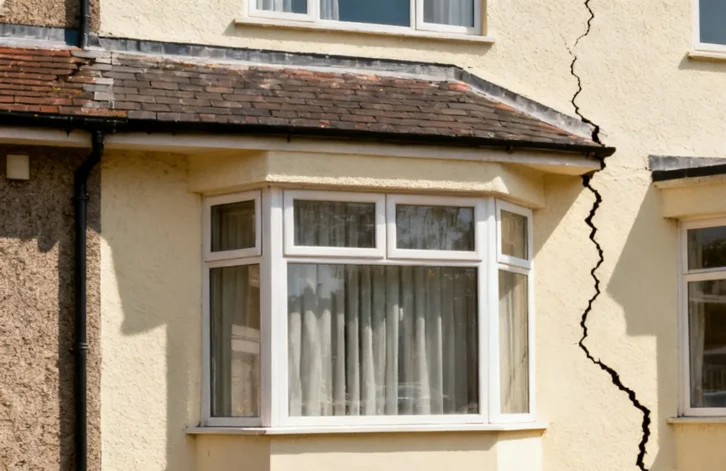
“There are cracks now throughout the house, diagonal cracks around almost every window, windows are getting harder to open and close, and the door lintels have dropped, so we have doors now that won’t close,” Biggs said. “In the main part of the house, the kitchen, dining room, the hallway, the floor is dropping and cracking because it’s just falling away in the middle.”
Another homeowner, Melissa, who works in the arts, lodged a subsidence claim in August 2026 for her 1901 home in Walthamstow, north London. She reported cracks wider than 1cm and a front door that had become difficult to open or close.
Insurance implications
Subsidence excess is typically higher than for other insurance perils, with figures exceeding £1,000 now common. For properties with a history of subsidence, despite underpinning works, the excess could rise to £10,000.
Modern housing layouts can affect the extent of claims, according to Worrall. Open-plan extensions, larger kitchens and interconnected living areas can mean that more extensive structural repairs are needed when subsidence occurs.
Farewell noted that differential movement causes the most significant problems, occurring when a house is built across two different soil types or when trees dry out soil unevenly. He added that failures in old water pipes during summer can indicate increasing subsidence risk in a region, as these pipes are more vulnerable to ground movement than houses.
The increase in subsidence claims adds to broader challenges facing the property insurance sector, with landlords already facing increased costs and letting agents adjusting their fee structures in response to regulatory changes.
Signs of subsidence include widening diagonal cracks, typically around window and door frames, sloping floors, and sticking doors and windows. The British Geological Survey data shows that soils in Eastern England hit record dryness levels in summer 2026.