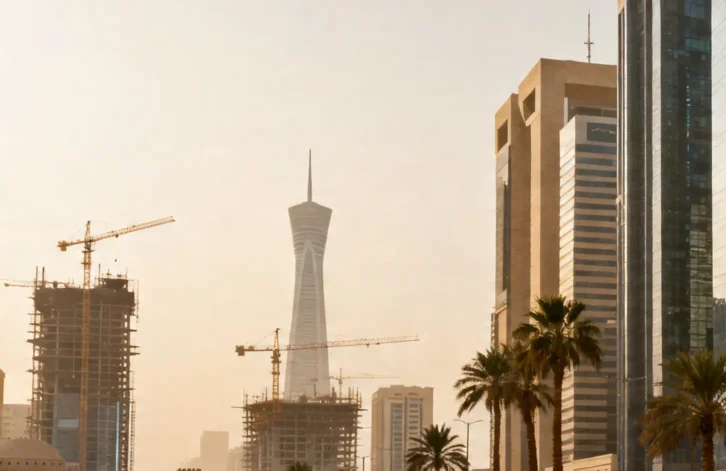
Riyadh’s real estate market is attracting increased international investor interest as Saudi Arabia’s Vision 2030 economic diversification programme drives infrastructure spending and corporate relocations to the capital city.
The market, historically dominated by domestic buyers, is transitioning towards an international investment destination as multinational companies establish regional headquarters in the city and foreign ownership routes expand.
Infrastructure and economic drivers
Government investment in transport networks, including metro expansion, alongside growth in finance and technology sectors, is supporting housing demand across multiple districts. The capital is experiencing simultaneous increases in employment, infrastructure development and population growth.
Vision 2030 initiatives have directed capital towards roads, transport systems, commercial districts, residential communities and cultural destinations across Riyadh. Public investment in infrastructure is improving accessibility and desirability across various city districts.
Market segmentation and performance
Riyadh’s property market comprises multiple submarkets with varying performance characteristics. Northern districts continue to attract attention due to newer housing stock and accessibility, whilst areas near employment centres show demand from executive tenants.
Family villa communities remain significant in the Saudi market, with well-planned developments attracting both owner-occupiers and rental tenants. Demand for premium and branded residences is rising as the city’s international profile grows.
Similar patterns of foreign investor interest in Saudi Arabia’s off-plan market have been observed across the Kingdom’s major cities.
Diriyah development project
The Diriyah Gate Development Authority project combines cultural heritage with residential, hospitality and retail components. The government-backed development is positioned as a limited-supply ultra-prime district, with investors viewing it as a potential long-term prestige location.
The project aims to create a district combining tourism demand with residential supply in a heritage setting, with completion phases extending towards 2030.
Rental market dynamics
Rental demand in Riyadh is supported by a growing professional workforce, corporate relocations and demand for modern housing stock. Where existing supply falls below international standards, newer developments can command pricing premiums.
The market benefits from a domestic demand base including government employment, business migration and family housing requirements, providing resilience compared to markets dependent primarily on foreign buyers.
Off-plan investment approach
Off-plan purchases in Riyadh typically offer lower entry pricing, payment plans during construction periods and unit selection advantages. However, market participants emphasise the importance of developer reputation, district fundamentals and pricing relative to comparable properties.
Whilst landlord property sales have declined in some markets, Riyadh’s off-plan sector continues to attract buyers targeting capital appreciation before completion.
Investment strategies and risk factors
Investor approaches vary from capital growth strategies focused on districts with infrastructure support, to income strategies targeting units near employment hubs. Some investors acquire properties in premium communities for personal use alongside investment purposes.
Risk considerations include location selection, pricing during launch phases, developer execution capability, supply levels in specific areas and unit type alignment with demand patterns.
Market positioning and outlook
Analysts note Riyadh’s market cycle stage differs from mature gateway cities, some of which face lower yields, higher taxation and fully priced valuations. The capital offers exposure to an earlier-stage market cycle with a domestic demand base and large-scale economic transformation.
By 2030, projections suggest Riyadh may feature expanded international corporate presence, greater public transport usage, enhanced entertainment and lifestyle offerings, additional premium districts and increased global investor recognition.
The market appears to be progressing through an awareness-to-entry phase, with institutional and mainstream global demand potentially following current early-stage international participation. Market observers suggest the 2026-2030 period represents a transitional window before broader global consensus on the market’s positioning.
Investment approaches prioritising prime districts, established developers and medium-term holding periods are common amongst institutional buyers entering the market. The domestic demand layer, including resident population, government employment and business migration, provides fundamental support distinct from resort-focused property markets.