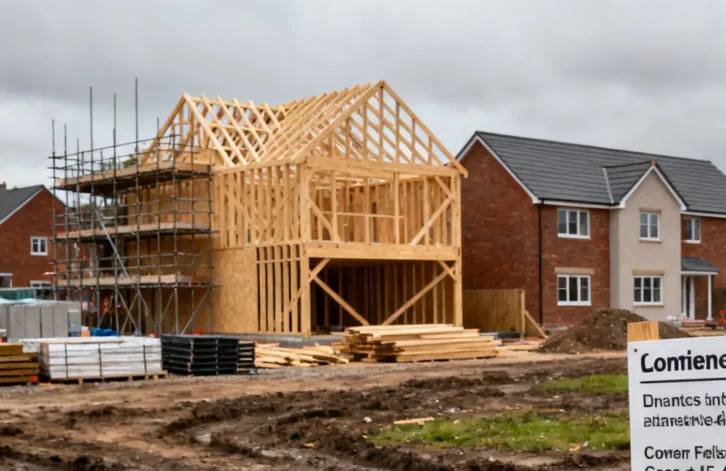
Britain’s housing shortage and weak economic growth stem from decades of restrictive planning policy rather than a lack of available land, according to a new report from the Institute of Economic Affairs (IEA).
The briefing argues that the country’s inability to build sufficient homes, commercial property and infrastructure has become a major barrier to economic growth, describing the situation as “entirely self-inflicted”.
Written by IEA editorial director Kristian Niemietz, the report forms part of the think tank’s forthcoming book, The Great Stagnation: Why Britain Stopped Growing, which examines the causes of the UK’s prolonged period of weak economic performance.
Housebuilding rates halved over six decades
The report highlights a sharp slowdown in housebuilding over the past 60 years. Between the mid-19th century and the mid-20th century, the housing stock typically grew by between 1% and 2% annually. Annual growth has since fallen to around 0.5%, contributing to ongoing pressure on house prices.
According to the IEA, the shortage extends beyond residential property, with a lack of commercial premises increasing business costs, reducing productivity and limiting expansion in some of the country’s most economically productive areas.
The report challenges the perception that England is overdeveloped, noting that only around one-tenth of the country is built on, while almost two-thirds remains agricultural land.
Market implications for investors
The findings suggest that supply constraints are likely to continue supporting property values in the near term, particularly in high-demand areas where development faces the greatest planning resistance. The analysis comes as 1.5 million UK properties face challenges with mortgage lending due to various structural issues.
The IEA argues that successive governments have recognised the problem for more than two decades through policy papers and reviews, but have failed to implement reforms capable of significantly increasing development rates.
Dr Kristian Niemietz, economist and author of the briefing, said: “The thesis of this briefing is that Britain has stopped growing, because the British economy is rubbing up against physical capacity constraints. We are trying to squeeze a twenty-first-century economy into the physical built-up environment we have inherited from the previous two centuries, and we refuse to expand that capacity to anything like the degree that is required.”
Lord Hannan, director general of the Institute of Economic Affairs, added: “Every fast-growing economy in history got that way partly by using more of what it already had: more land, more buildings, more space to work and live in. Ours stopped, because regulators, with mostly good intentions, built a system that lets NIMBY objectors veto growth while rationing land in a country that’s ninety per cent undeveloped.”
The briefing is the second in the IEA’s Great Stagnation series, with further reports due ahead of the publication of the full book later this year.